New Dream For Old Mill

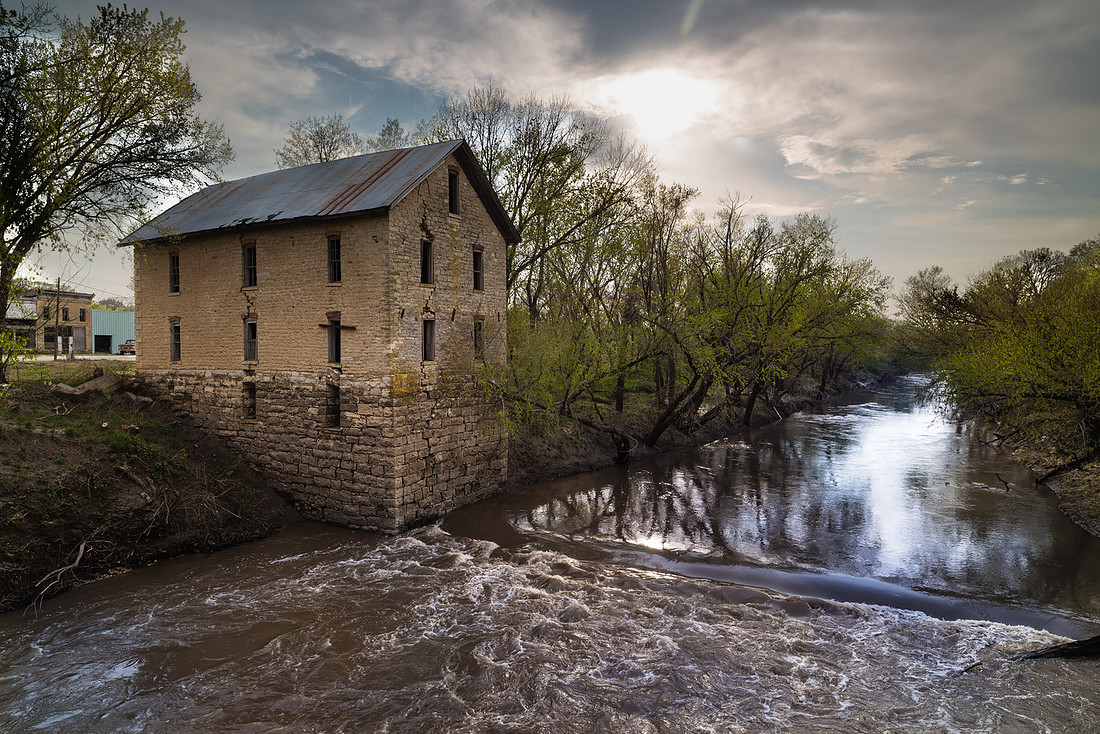 Seirer_170407_3921.jpgNew Dream For Old Mill Even with cracks in the walls, mud in the basement and deteriorating timbers, a 142-year-old gristmill at Cedar Point, out of service for years, stands as a monument to ingenuity, frontier architecture and pluck. Little wonder it’s the target of a restoration project, estimated to cost some $3 million. The Drinkwater and Shriver Mill was built on the south bank of the Cottonwood River at Cedar Point, beginning in 1871. That was just before the railroad arrived so the builders, O.H. Drinkwater and P.P. Schriver, needed to draw on creativity to get building materials and equipment to the remote Chase County site. When the mill was finished in 1875, the river’s current provided the power to drive the pulleys and belts that carried wheat harvested in the surrounding river bottomland to the top of the building, where the seed was separated, diverted to wooden chutes and allowed to flow, by gravity, back to ground level for milling, with a stone grinder, into flour. The flour was bagged and sold to the growing population in the valley. Dan Clothier, a Kansas City property developer who has ties to central Kansas, is leading the restoration effort, driven by a love of history, architecture and the Flint Hills. He notes that the mill was one of the first built in Kansas; within a quarter of a century more than 500 mills were counted in the state. His dream is to preserve the limestone building so it can house a museum to showcase its charms and tell the story of Kansas frontier development and early-day milling. Some work has been done. The site has been cleaned, and a 1903 wood-and-tin addition to the mill has been removed, revealing a handsome limestone façade that surprised all of the Cedar Point residents — only a couple of dozen or so at last count. That façade fronts and is a key element of the town’s remaining business district. In the 1920s, the mill and river team could grind about 250 bushels of wheat in 12 hours. In the Dust Bowl days of the 1930s, the river went dry for a while. In the 1940s, the mill’s work was to mill feed for cattle, and after the war the mill relied on electricity instead of the river for its power. All operations ceased in the 1960s and the mill languished until Clothier began work to bring it back to life in an educational role. He formed a nonprofit organization, the Drinkwater and Schriver Mill Inc., and serves as its president. That organization has bought the property. Since then, the mill has been added to the National Register of Historic Places and a team of architectural students at Kansas State University has come up with a concept for restoration, though that work won’t begin until funds are raised. This is a long-term project, Clothier said. But so be it. The building is stable for now and he’s long been known for optimism. Regional publications have been attracted to the story and the mill, with Cedar Point being less than a mile south of busy U.S. Highway 50, draws a steady stream of visitors. A large sign at the mill explains the project and directs people to the nonprofit organization’s web site, www.cedarpointmill.com, and to Clothier, who fields calls from his Leawood home, (816) 808-1610.
Even with cracks in the walls, mud in the basement and deteriorating timbers, a 142-year-old gristmill at Cedar Point, out of service for years, stands as a monument to ingenuity, frontier architecture and pluck. Little wonder it’s the target of a restoration project, estimated to cost some $3 million.
The Drinkwater and Shriver Mill was built on the south bank of the Cottonwood River at Cedar Point, beginning in 1871. That was just before the railroad arrived so the builders, O.H. Drinkwater and P.P. Schriver, needed to draw on creativity to get building materials and equipment to the remote Chase County site. When the mill was finished in 1875, the river’s current provided the power to drive the pulleys and belts that carried wheat harvested in the surrounding river bottomland to the top of the building, where the seed was separated, diverted to wooden chutes and allowed to flow, by gravity, back to ground level for milling, with a stone grinder, into flour. The flour was bagged and sold to the growing population in the valley.
Dan Clothier, a Kansas City property developer who has ties to central Kansas, is leading the restoration effort, driven by a love of history, architecture and the Flint Hills. He notes that the mill was one of the first built in Kansas; within a quarter of a century more than 500 mills were counted in the state. His dream is to preserve the limestone building so it can house a museum to showcase its charms and tell the story of Kansas frontier development and early-day milling.
Some work has been done. The site has been cleaned, and a 1903 wood-and-tin addition to the mill has been removed, revealing a handsome limestone façade that surprised all of the Cedar Point residents — only a couple of dozen or so at last count. That façade fronts and is a key element of the town’s remaining business district.
In the 1920s, the mill and river team could grind about 250 bushels of wheat in 12 hours. In the Dust Bowl days of the 1930s, the river went dry for a while. In the 1940s, the mill’s work was to mill feed for cattle, and after the war the mill relied on electricity instead of the river for its power. All operations ceased in the 1960s and the mill languished until Clothier began work to bring it back to life in an educational role. He formed a nonprofit organization, the Drinkwater and Schriver Mill Inc., and serves as its president. That organization has bought the property. Since then, the mill has been added to the National Register of Historic Places and a team of architectural students at Kansas State University has come up with a concept for restoration, though that work won’t begin until funds are raised.
This is a long-term project, Clothier said. But so be it. The building is stable for now and he’s long been known for optimism. Regional publications have been attracted to the story and the mill, with Cedar Point being less than a mile south of busy U.S. Highway 50, draws a steady stream of visitors. A large sign at the mill explains the project and directs people to the nonprofit organization’s web site, www.cedarpointmill.com, and to Clothier, who fields calls from his Leawood home, (816) 808-1610.
|
January
(2)
February (2)
(9)
March (9)
(17)
April (17)
(13)
May (13)
(9)
June (9)
(9)
July (9)
(13)
August (13)
(4)
September (4)
(6)
October (6)
(7)
November (7)
(2)
December (2)
|
(3)
January (3)
(4)
February (4)
(2)
March (2)
(11)
April (11)
(13)
May (13)
June
July
(5)
August (5)
(7)
September (7)
(7)
October (7)
(12)
November (12)
(4)
December (4)
|
(2)
January (2)
(6)
February (6)
(9)
March (9)
(6)
April (6)
(5)
May (5)
(6)
June (6)
(5)
July (5)
August
(1)
September (1)
(2)
October (2)
(3)
November (3)
December
|
January
(3)
February (3)
March
April
(2)
May (2)
June
July
August
September
October
November
December
|
January
February
March
April
May
June
July
August
September
October
November
December
|
January
February
March
April
May
June
July
August
September
October
November
December
|
January
February
March
April
May
June
July
August
September
October
November
December
|
January
February
March
April
May
June
July
August
September
October
November
December
|
January
February
March
April
May
June
July
August
September
October
November
December
|
January
February
March
April
May
June
July
August
September
October
November
December
|